


goldwoven
Sep 6, 2026
Compare shelf openings, outside dimensions, taper, handles and usable interior space before approving storage baskets for shelves.
A shelf basket should be approved against two different measurements: the space it occupies outside and the storage space it provides inside. Start by measuring the narrowest usable shelf opening, then compare it with the basket’s widest rim, handles, depth and height. After that, check whether the top opening and tapered base can actually hold the intended contents.
There is no universal clearance that works for every project. The right allowance changes with the shelf construction, basket shape, dimensional variation, handle position and pull-out movement. Buyers comparing formats can first review Goldwoven’s home storage baskets, then test a physical sample in the intended shelf rather than relying on a nominal cube size.
Measure the Shelf Opening as a Usable Space
A furniture specification may describe the overall cube or cabinet, not the unobstructed space available to a basket. Measure the clear opening at the front first, because a face frame, shelf support or door fitting can make the entrance narrower than the compartment behind it.
Record the clear width between the side panels, the clear height above the shelf surface and the usable depth from the front edge to the rear obstruction. Repeat the width and height measurements farther inside the compartment if the panels are not parallel or if hardware reduces the space at only one point.
The smallest relevant measurement controls entry. A basket that fits the internal width but cannot pass through the front frame is not a workable fit, even if it could sit comfortably once inside. The same applies to a shelf with a raised front lip, projecting hinge or bowed surface.
The required front position should also be defined before choosing the basket depth. A basket may need to sit behind a cabinet door, align approximately with the shelf edge or project slightly so that a pull handle remains accessible. These are different fit conditions and should not share one generic depth specification.
Measure the Basket Outside at Its Widest Points
The basket’s exterior measurements determine whether it can enter the shelf, sit in the intended position and move without catching. Measure the physical sample at its maximum points instead of assuming that the base, body and top rim share the same width.
Record the maximum outside width, maximum depth and overall height. Then identify what creates each maximum: the rim, woven body, frame, handle or another projecting detail. Measuring both sides can reveal an uneven rim or handle position that a single centreline measurement would miss.
For tapered woven shelf baskets, record the outside width and depth at both the top and base. The top may control entry while the base determines how the basket sits on the shelf. Neither measurement explains the complete fit on its own.
Goldwoven’s two-tone woven seagrass storage basket with handles is a relevant form reference because its product page identifies a tapered rectangular body and side handles. The page currently publishes a size of 42 × 30.5 × 21.6 cm, but the width, depth and height order—and the exact measuring points—should be confirmed before using those figures in a shelf plan.
Check the Usable Interior Against the Contents
Exterior fit answers whether the basket can occupy the shelf. Usable interior answers whether it can perform the intended storage job. Tapered walls, a thick rim, internal framing, curved corners and liners can all reduce the space available to the contents.
Measure the top opening from inside edge to inside edge, then measure the internal width and depth at the base. Record the usable height below the rim and note any space taken by inward-facing handle attachments, dividers or other components.
Rigid contents require particular attention. A box may fit the base dimensions but fail to pass through a narrower top opening, while a group of folded items may enter easily but lose too much capacity near the tapered base. Test the actual contents or dimensionally accurate mock-ups in the arrangement expected during normal use.
Do not calculate capacity by multiplying the basket’s outside width, depth and height. That calculation treats the product as an empty straight-sided box and ignores wall thickness, taper and internal obstructions. For shelf basket sizing, usable dimensions provide a more practical approval record than an estimated exterior volume.
Allow for Handles, Taper and Front Projection
Handles must be measured in the positions they occupy during insertion, storage and removal. A flexible loop may rest against the basket when it is on the shelf but extend outward when grasped. A rigid side handle may create the basket’s widest point, while a front pull handle can change how far the product projects beyond the shelf.
Taper changes fit in two directions at once. It can provide a smaller base footprint while bringing the upper rim closer to the shelf sides, and it reduces the internal floor area available for rectangular contents. A top-view check should therefore show the shelf opening, maximum rim, handle projection and base—not just one outside width.
Front projection should be treated as a design decision rather than an automatic failure. A slight projection may keep a handle accessible on an open shelf, but the same arrangement may prevent a cabinet door from closing or disrupt the alignment of a retail display. The specification should state the intended front line before the sample is judged.
Height also affects removal. Some baskets must be lifted slightly before they can be pulled forward, particularly when the base, shelf lip or contents create resistance. A basket may look correctly sized while stationary yet remain difficult to remove because there is too little space for that lifting movement.
Test the Loaded Basket and Pull-Out Movement
A meaningful fit test combines the shelf, basket and intended load. Insert the basket without forcing the rim or handles, arrange the contents as they will normally be stored, then pull the basket forward, remove it and return it to the shelf. Contact, snagging or awkward hand movement should be recorded at the point where it occurs.
Repeat the test with the neighbouring baskets installed. A sample may work well alone but become difficult to grasp when several baskets are grouped across one shelf. Handles can touch, irregular rims can interrupt alignment, and a narrow gap may provide visual clearance without enough room for fingers.
Three failure patterns deserve special attention. The basket may stick because the recorded width excluded a handle or uneven rim; it may enter but provide too little internal space because the tapered base is narrow; or it may sit correctly but resist removal because the user cannot reach the handle or lift the front edge.
Test more than an empty presentation sample. The contents can change the basket’s balance, removal angle and handling method. For a retail range or repeated installation, the approval record should identify the shelf unit, sample, contents and test date so that the result can be traced later.
Build a Two-Sided Shelf-Fit Worksheet
Keep shelf measurements on one side of the approval record and basket measurements on the other. This prevents a label such as “width” from being used for the shelf opening, basket rim and usable base without identifying which measurement it represents.
The shelf side should record the front clear width, minimum internal width, clear opening height, usable depth, obstructions and required front position. It should also identify the actual shelf unit or location and the number of baskets intended to sit together.
The basket side should record the maximum exterior width, top and base dimensions, overall height, handle projection, usable top opening, usable base and internal height. Add the contents dimensions, loading arrangement, sample identification and result of the loaded pull-out test.
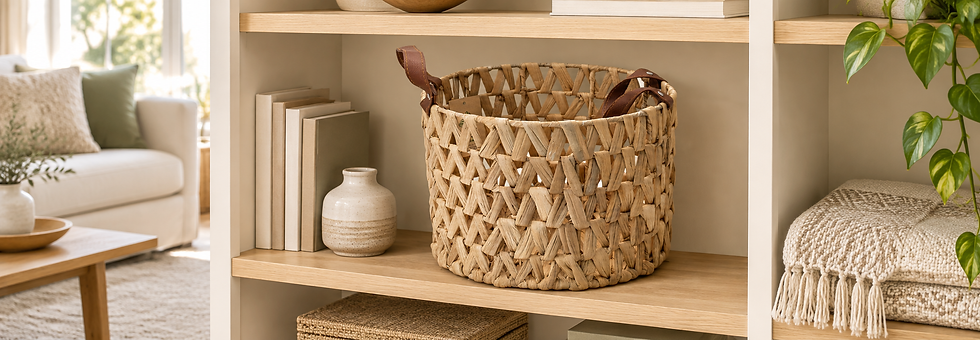
Photographs from the front, top and side can support the record when they show the exact sample and shelf used. The photograph should clarify where each measurement begins and ends; a styled image alone cannot prove shelf clearance or usable interior space.
If no standard format can provide enough interior space while staying within the shelf opening, a custom woven basket size may be justified. Send the complete worksheet rather than one nominal outside dimension so that the shelf opening, usable interior, handle access and required front position can be reviewed together.
A sample should still be tested before final approval. Product images can help shortlist a shape, but they cannot confirm the measuring points, dimensional variation, usable capacity or loaded pull-out movement required by a specific shelf system.