


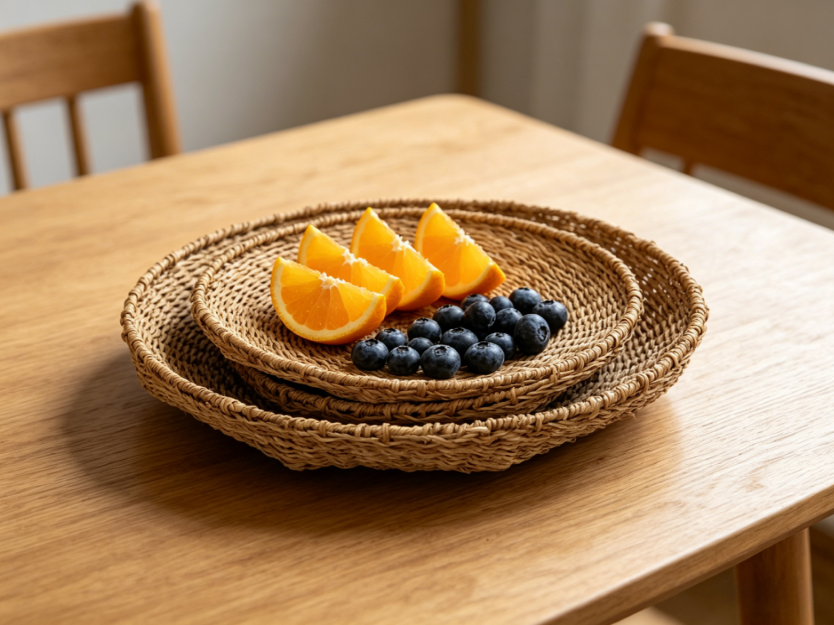
goldwoven
Apr 30, 2026
How Wholesale Woven Baskets and Decorative Trays Elevate Tabletop Styling and Gift Displays
In a well-shaped collection, wholesale woven baskets and decorative trays should not do the same job. A basket usually adds depth. A tray, on the other hand, gives a surface a frame. That is why trays work so well for tabletop styling, flat gifting, breakfast setup, and hospitality display. Goldwoven already treats Tray as a separate category, with handled seagrass trays, PP rattan serving trays, scalloped styles, and nested sets grouped as their own collection.
That separation makes sense. A tray can pull a few small items together in seconds, and the result looks finished without much effort. A candle, folded napkin, tea tin, or bottle looks more intentional when it sits inside a tray boundary. That simple effect is the real reason tray collections deserve attention.
Quick Summary
Trays work best as a standalone category because they solve surface display, gift presentation, and service setups in a cleaner way than deep baskets.
The strongest tray assortments are usually built around a few clear scenes: tabletop, gifting, hospitality, breakfast service, and vanity display.
Shape, rim depth, and handle style matter more than trend language. A rectangular handled tray and a scalloped decorative tray belong to different jobs.
When trays and baskets are matched by function, the full woven assortment feels more useful and easier to merchandise.
Why woven trays deserve a standalone collection
A tray line should not sit under baskets as an afterthought. It reads better when it stands on its own. Goldwoven’s Tray category already shows that direction clearly, with rectangular, round, square, scalloped, petal-shaped, and nested woven tray formats presented as a separate family rather than hidden inside storage products.
That matters because trays solve a different problem. They are not mainly about storage. They are about placement. On a table, a tray keeps cups, jars, or folded textiles from drifting. On a shelf, it turns loose small pieces into one clean visual unit. In gift use, it creates an open base instead of a deep container.
A good tray collection also moves faster in photography. One overhead shot explains the product immediately. One side view shows the rim. One styled image shows the use. That simplicity is part of the appeal.
The orange nested PP rattan set is a good example. It works as a practical pair, but it also explains the value of sets at a glance. Goldwoven lists this product as Set of 2 Vibrant Orange PP Rattan Trays - Stackable Waterproof Serving Set, which makes it easy to place in seasonal tabletop stories, flat gifting, or brighter promotional collections.
Decorative trays for tabletop gifting and display
For flat presentation, trays do a job baskets cannot do as neatly. They keep the contents visible. That matters for tea sets, candle groupings, wrapped soaps, mini jars, folded napkins, or any gift arrangement where the top view needs to look complete.
The effect is small but real. A few items placed directly on a table can look scattered. The same items on a tray look composed. That is why decorative trays work so well in gift assembly, breakfast styling, coffee table display, and small hospitality moments. Goldwoven’s tray category description also places trays in decorative display, tabletop styling, serving, organization, and gift presentation, which fits this use exactly.
Round trays usually soften a scene. Rectangular trays feel more orderly. Scalloped rims add lift without asking too much from the rest of the styling. The strongest collections keep those roles clear instead of mixing everything into one vague “home decor” idea.
Goldwoven lists this handled piece as Rectangular Handwoven Seagrass Tray with Handles - Rustic Coffee Table Organizer. It sits in a very useful middle zone: warm enough for decorative display, but still structured enough for breakfast, bread service, or gift packing.
Size rim and handle choices that matter
Tray size should follow use first. A smaller tray fits vanity items, candles, keys, or a shelf display. A mid-size tray usually does the most work because it handles cups, jars, folded linens, bottles, and flat gift layouts without taking over the whole surface. Larger trays fit coffee tables, buffet stations, and room-use setups better.
Rim depth matters just as much. A low rim feels open and works well for decorative display. A medium rim is often the safest choice because it still looks light while helping items stay grouped. A deeper rim can make sense for room service, hospitality, or more active surface use, though it should still read as a tray, not a shallow basket.
Handles should solve a real task. If the tray moves, handles help. If it stays on one surface, handle-free forms can look calmer. Goldwoven’s visible tray range includes woven cut-out handles, leather handles, metal handles, and simple integrated side grips, which makes the functional split easy to read across the category.
Rectangle is still the safest commercial shape. It fits packaged goods, folded textiles, cups, and bottles with very little waste. Round trays soften a tabletop and often feel better for candles, bath sets, and softer styling stories. Square trays can look very clean on vanities or shelves.
Matching woven trays with baskets in one assortment
A tray and a basket should be matched by role, not just by weave. The tray defines the surface. The basket adds depth. Once that rule is clear, the whole collection feels sharper.
For example, a breakfast setup can use a tray for cups, jam, and folded napkins, while a basket nearby carries fruit or bread. A gift story can use a tray for the visible hero items, while a basket version handles larger bundled pieces. That is a better pairing logic than forcing every item to look like a resized copy of the next one.
This is why a tray category supports wholesale woven baskets so well. It extends the woven language into flat display, tabletop use, and hospitality without pulling the range into unrelated materials. Goldwoven’s homepage presents the broader woven basket direction, while the Tray page gives that same material story a dedicated surface-based category.
It also helps to give decorative trays a clear route inside the product structure. When trays stay visible as their own destination, the category feels intentional instead of tucked away under generic storage.
Goldwoven names this one Dark Brown PP Rattan Serving Tray - Durable Woven Food Platter with Metal Handle. It is a strong reference for hospitality, minibar, breakfast, and room-use programs because the shape is stable and the metal handle detail gives it a firmer service feel.
Private label opportunities for tray programs
Tray collections are often easier to shape than people expect. The base form is simple, so small adjustments stay visible. A darker finish, a cleaner weave, a scalloped edge, or a contrast handle can shift the whole mood of the tray without overcomplicating the product.
That is useful for private label work because trays are seen from above, from the side, and in stacked sets. Details show clearly in photography. Goldwoven’s tray page also states support for tray wholesale programs and flexible development, including options around size, material, color, finish, and packaging.
One good rule here is restraint. A tray line does not need too many decorative ideas at once. Usually, one finish family plus one accent story is enough. That keeps the collection readable.
Goldwoven lists this product as Elegant Paper Rope Lace Tray - Scalloped Edge Decorative Vanity Organizer. It is a good reminder that one edge detail can do enough. The tray feels softer and more decorative, but the product still stays easy to use in vanity, gift, or tabletop display scenes.
Bulk buying checklist for tray collections
A tray range gets stronger when the first decisions stay simple. Start with use scenes. Then choose the shape ladder. Then define the handle logic. Most of the noise disappears after that.
For a first workable range, one rectangular tray, one round tray, and one set format usually cover a lot. That gives enough variety for tabletop, gifting, and hospitality without making the category feel crowded. Goldwoven’s current tray page already shows that mix through rectangular handled trays, round decorative trays, and nested PP rattan sets.
Packing should come in early. Trays are shallow, so rims matter. Nested formats save space and look good in catalog shots, but they still need sensible spacing and orientation. Handle type matters here too, especially when leather loops, metal handles, or decorative edges are involved.
Near the close of the article, the role stays clear: wholesale woven baskets carry the wider woven story, while trays add a cleaner surface-based layer for gifting, hospitality, and display. That is why a tray program feels like a natural extension, not a side project.
Buyer Checklist
Keep the first assortment focused on three to five real use scenes.
Start with one rectangle, one round, and one set.
Decide early whether each tray is display-led or service-led.
Review rim depth as carefully as length and width.
Use handle style to support function, not just decoration.
Keep material and finish stories easy to read.
Separate single trays and set trays in merchandising.
Give decorative trays a clear category path in the range.
Comparison Table
Tray Type | Best Use | Main Advantage | Finish Mood |
Rectangular handled tray | Breakfast, hospitality, folded linens, packaged goods | Easy to place and easy to organize | Practical, commercial |
Round tray | Candles, bath sets, center display, softer tabletop styling | Softens the surface and keeps layouts open | Relaxed, warm |
Nested tray set | Seasonal display, gifting, promotions | Saves space and creates a size ladder | Display-friendly |
Scalloped decorative tray | Vanity, floral tabletop, gift presentation | Adds shape interest without much extra styling | Softer, decorative |
Dark-toned service tray | Minibar, room-use, buffet-side display | Feels stable and more structured | Tailored, grounded |