


goldwoven
Apr 24, 2026
How woven home storage baskets create calm, retail-ready storage lines for modern home collections
A good storage line rarely starts with a catalog grid. More often, it starts with a room that feels slightly off. A shelf looks crowded even when nothing on it is especially messy. A hallway bench becomes a landing spot for scarves, tote bags, and unopened post. A bedroom corner gathers spare blankets, magazines, and small loose things that somehow never settle. That is where wholesale woven baskets and woven home storage baskets start to matter.
What makes this category work is not only the practical side. Of course, a basket stores things. That part is obvious. The more interesting part is how it changes the room while doing the job. A woven basket softens hard lines, gathers visual clutter, and adds texture in a way that still feels calm. It does not look as cold as plastic, as severe as metal, or as temporary as a weak fabric bin. It lands in a better middle ground.
That middle ground is exactly why the category travels so well across modern home collections. A shelf basket can live in a living room and still feel right in a guest bedroom later. A lidded storage box can work in a closet, then move to a hallway console, then end up on an office shelf holding paper goods. A handled open-top basket can hold magazines one month and rolled towels the next. The shape stays useful because the use pattern stays familiar.
There is also a reason woven storage feels more human. Most rooms do not need more “systems.” They need quieter habits. A throw blanket needs a place near the sofa at night. A stack of bedtime books needs a home in a child’s room. Spare toiletries need to stop wandering around a bathroom shelf. Charging cables need somewhere to go other than the tabletop. Home storage works best when it supports those small routines without making the room feel more mechanical.
That is why a strong collection of wholesale woven baskets should never feel like warehouse logic pushed into a living space. It should feel useful, shelf-friendly, and easy to place in real interiors. In the same way, woven home storage baskets work best when they look natural in open shelves, wardrobes, bedrooms, entryways, and calm family spaces instead of feeling limited to one decorative corner.
Why woven storage feels more natural in real homes
Some storage products solve a practical problem and create a visual one. That is the quiet trap of this category. A clear plastic box may hold plenty, yet it can make an open shelf feel colder. A metal container may look tidy in theory, yet it can make a bedroom look harder than it needs to. Fabric bins can feel soft, but some lose shape quickly and start to look tired before the season ends.
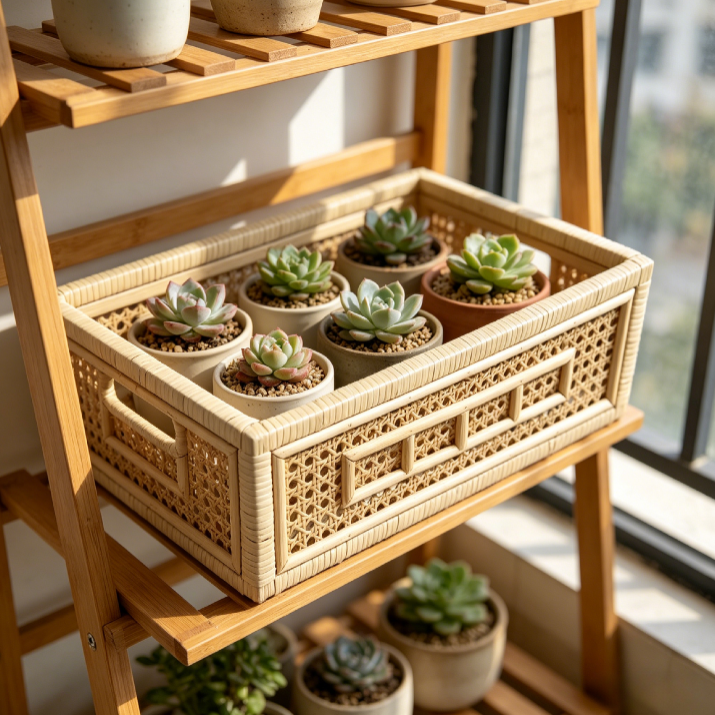
Woven storage avoids that problem because it has texture and structure at the same time. The basket still holds its form. However, the surface reads warmer, softer, and more settled. On a shelf with books, framed photos, folded throws, and ceramics, woven texture feels like part of the scene rather than a strict functional interruption. That matters because a storage basket in the home is almost never invisible. It keeps being seen.
The visual effect is immediate. A shelf with six unrelated loose objects looks noisy. The same shelf with three of those objects gathered inside one basket often looks calmer within seconds. The room does not need a major makeover. It just needs fewer scattered edges competing for attention. Woven baskets are good at doing that without becoming heavy.
Another reason the category works is adaptability. In one home, a square basket may sit under a console table and hold pet toys. In another, the same shape may sit inside a wardrobe cube and hold knitwear. In a guest room, a low rectangular basket may hold spare towels and a hairdryer. In a living room, an open handled basket may sit near the sofa with a folded throw and a current magazine. The basket does not depend on one exact story. It works because it fits repeated domestic habits.
That flexibility gives the line stronger long-term value. Trends come and go, but storage that feels quiet, useful, and visually warm usually keeps a place in the home. That is one reason this category stays relevant for retail-ready collections. It does not need a dramatic trend cycle to justify itself.
Why woven home storage baskets work in retail and in real use
Some home products look better in a styled photograph than they do in a daily routine. Storage baskets do not have that luxury. They have to survive both. They need to look good enough to support shelf presentation, photography, and collection styling, but they also need to work on a Tuesday night when the room is being put back together after a long day.
That is why woven home storage baskets tend to perform better than more novelty-driven or purely decorative containers. A useful basket earns its place through repetition. It gets picked up, filled, emptied, moved, and noticed again. If it still feels right after those repeated moments, the shape is doing its job.
A good home storage basket usually solves at least two problems at once. First, it creates order. Second, it makes that order feel softer and more natural. That second part is easy to underestimate. People rarely buy storage because they want to look at containers. They buy storage because they want the room to feel easier to live in. A woven basket helps because it tidies the room without bringing a hard industrial mood with it.
This matters on the retail side too. A line of woven storage baskets can support more than one home story at the same time. It can fit a calm modern-natural assortment, a family-living assortment, a light coastal story, a softer neutral bedroom story, or a warm gifting-oriented home line. That flexibility gives the collection room to travel.
There is also a practical merchandising advantage. A woven basket does not need loud embellishment to carry attention. The texture already does some of the work. That means the line can remain visually calm while still feeling interesting. On a shelf, that often reads as more premium than a product that tries too hard to be noticed.
The room scenes that make this category easy to understand
The easiest way to understand woven storage is to stop talking about it in abstract terms and start picturing actual rooms.
Think first about a living room shelf in the evening. There may be two books, one remote, a charging cable, folded glasses, and a notebook that never quite belongs anywhere. None of those objects is dramatic. Together, though, they make the shelf feel restless. A square open-top basket changes the whole scene because it turns several small visual interruptions into one calm shape. The room feels more composed without becoming formal.
Now think about a hallway bench. This is where daily life tends to leave little traces behind. A scarf gets dropped there in the morning. A tote bag slides underneath by lunch. Mail lands on the bench by late afternoon. A shallow rectangular basket or a lower handled piece underneath the bench can take care of most of that quickly. The result does not feel over-designed. It just feels easier.
A bedroom is another strong setting. Open wardrobes and shelf units often look inviting in photos, yet they can become messy in real use very quickly. Smaller garments, folded sleepwear, accessories, and soft daily items rarely stay in neat stacks forever. A basket gives them a boundary. The shelf looks calmer, and the room gains a more settled rhythm.
Bathrooms also benefit from woven storage because the material softens the harder surfaces around it. Tile, glass, chrome, and stone can feel slightly sharp without a warmer counterbalance. A basket with spare towels, extra toilet paper, or small grooming items makes the room feel less temporary. It introduces texture in a space that often needs it.
Then there are shared family areas. Those rooms do not stay perfect, nor should they. Still, a larger basket for toys, a rectangular handled basket for coloring books, or a shelf basket for puzzles can make resetting the room far easier. In those spaces, storage should feel approachable. It should help without looking too precious.
Best rooms and product sets for home storage baskets wholesale
A useful home storage program usually becomes stronger when it is planned by repeat use pattern rather than by rigid room labels. The same basket can cross from one room to another very naturally if the form is right. So the better question is not “Which basket only fits a living room?” The better question is “Which shape solves a job that keeps showing up across different parts of the home?”
One of the most reliable product groups is the shelf set. This set usually includes one cube or near-cube basket, one medium handled rectangle, and one lower, shallower basket. Those three forms already cover a lot: bookshelves, sideboards, wardrobe cubbies, entry consoles, and open shelf units. The line feels related, but not repetitive.
Another helpful group is the concealed-storage set. This usually depends on one or two flatter lidded forms. The goal here is visual quiet. These baskets are good for wardrobes, upper shelves, calmer office corners, guest rooms, and bedroom storage where mixed contents need to stay out of sight.
Then there is the everyday-reach group. These baskets support spaces that are touched often. Think living rooms, family shelves, children’s rooms, and flexible household zones where things move in and out all week. Open-top baskets usually perform best here because speed matters. If the basket slows the routine down, it will stop feeling helpful.
A fourth group is the styled-storage set. This group works in calmer display settings where the basket needs to feel useful and attractive at the same time. Nested forms, lower rectangles, and softly textured shapes help here because they bring visual rhythm without looking too strict.
This is exactly why a line of woven home storage baskets feels stronger when it includes contrast. Not random contrast. Useful contrast. One cube. One open rectangle. One low basket. One lidded form. One nested pair. That kind of range feels complete. A line with six almost-identical rectangles usually does not.
Why nested baskets make a collection feel softer
Nested baskets are often treated like a small extra, but they do more work than they seem to at first glance. They add scale difference. They show the relationship between pieces quickly. They also make the collection feel less rigid.
A shelf full of only single rigid forms can start to look too uniform. A nested pair breaks that up. It creates a more relaxed visual rhythm, especially in living spaces, sideboards, and shelf-styled home settings. That relaxed feeling is valuable because storage should never make a room look tense.
Nested baskets also help on the practical side. They can support bundling. They can create flexible size options within the same collection mood. They can also make styling easier because the smaller and larger forms already speak the same visual language.
That softer effect is one reason nested forms work so well in home storage collections. They do not merely add another SKU. They make the whole line feel more natural.
Why open-top baskets often become the most-used pieces
Open-top baskets are easy to underestimate. They look simple, and sometimes simple products get overlooked. In actual use, though, they often become the hardest-working part of the range.
There is no extra action to remember. No lid to lift. No closure to move aside. The hand drops something in, or pulls something out, and that is all. In a real home, that kind of easy interaction matters more than people expect.
That is why open-top baskets tend to work especially well for throws, pet items, books, toys, folded pyjamas, guest towels, magazines, or daily family objects that need to stay accessible. These are not items that benefit from too much ceremony. They benefit from a place that feels immediate and natural.
At the same time, the basket should still hold its shape. Too much collapse can make the piece feel weak. Too much stiffness can take away the warmth that makes woven storage appealing. The best versions sit in the middle.
This kind of basket often ends up doing more real work than a more decorative form because it fits the rhythm of daily life more easily.
Matching sizes and shapes to real shelving systems
A basket can look excellent on its own and still feel wrong the moment it meets an actual shelf. That problem shows up more often than it should, and it usually has nothing to do with beauty. It is about fit, access, and how the hand moves in real life.
Depth is one of the first things to judge carefully. A basket may technically fit the shelf opening, yet still feel awkward if it leaves no finger room at the front. That little margin matters. Without it, the basket becomes annoying to pull forward, awkward to reach into, and harder to use over time.
Height matters too. Tall sides are helpful when the contents are mixed, bulky, or likely to spill. Still, a tall basket can also reduce visibility and make a shelf feel visually heavy. Lower baskets often work better for folded linens, magazines, or light household items because they let the shelf breathe.
Width changes the mood of the collection more than expected. A narrow basket may look tidy but can become impractical if it holds too little. A very wide basket can feel useful, but it may make the display look heavier than necessary. A balanced line often mixes one compact cube, one medium rectangular basket, and one lower wider form to create better visual rhythm.
Handles deserve real attention too. Cutout handles often suit shelf baskets because they keep the silhouette clean and reduce extra bulk. Raised handles or applied loops can look charming, but they can interfere with shelf fit. In modular furniture, even small added width can become a problem.
Lids are another point of judgment. A lid can make a basket look calmer, but it also changes how the basket gets used. In a wardrobe or on a top shelf, that can be a good thing. On a lower everyday shelf, it can become one extra step that slowly makes the basket less welcome.
A useful home line usually includes these core shape roles:
one cube or near-cube for shelves
one medium open rectangle for flexible daily storage
one flatter lidded form for concealed storage
one softer or nested form to reduce visual rigidity
When those roles are clear, the collection feels easier to understand and easier to place in real rooms.
When lidded storage becomes the better answer
Open-top baskets usually win on speed, but lidded baskets still play an important role in a stronger assortment. They help create visual closure. That sounds simple, yet the effect is powerful. A shelf with open mixed objects feels active. A shelf with one or two lidded baskets feels quieter immediately.
That difference matters in bedrooms, guest rooms, offices, upper wardrobe shelves, and hallways where the goal is not just order, but a calmer room image. A lidded basket is useful for extra linens, seasonal accessories, spare cables, guest-room supplies, document overflow, or all the little household categories that never look especially attractive when exposed.
There is also a visual neatness that comes from the lid line itself. A flat top, a tidy rim, and a stable rectangular silhouette make the basket feel more resolved. In some interiors, that matters just as much as the storage function.
Still, a lidded basket should not be treated as a universal upgrade. It works best when concealment really improves the experience. Otherwise, the basket may start to feel a little too formal for the job.
That is why mixed collections often feel strongest. A few lidded forms support quieter, calmer storage zones. Open-top forms handle the daily movement. Together, the line feels more complete.
A lidded piece like this is especially useful when the line needs a calmer option for wardrobes, bedroom shelves, or more concealed parts of the home.
Lighter and darker tones, and how they change the room
Color in woven storage is usually less about bold contrast and more about mood. Small shifts in tone can change the whole feeling of the basket.
Lighter basket tones tend to make a room feel softer and more open. On pale shelving, in a guest room, beside a light wood bed, or in a calm living space, a light basket can provide texture without making the scene feel heavier. That is useful because storage should support the room rather than take over the room.
Darker tones usually feel more grounded. They can define a storage zone more strongly and bring extra visual structure to a living space or family setting. A dark handled basket beside a sofa, for example, can feel sturdy and anchored without looking harsh.
The strongest lines usually do not force one tone into every situation. They keep a clear visual family, but allow enough tonal range to support different room stories. A light shelf basket and a deeper open-top family basket can still belong in the same collection if the weaving direction, shape language, and overall mood remain consistent.
This is especially important in open display settings. Too many unrelated tones and finishes can make a shelf look unsettled. A disciplined woven line helps the room stay coherent.
Lighter forms like this are particularly helpful in softer bedroom stories, guest spaces, and shelf arrangements that need storage without visual heaviness.
Why texture matters more than people first think
Shape is important, but surface often makes the first emotional impression. That is especially true in woven storage. A basket may be technically useful, yet if the surface feels flat, synthetic in the wrong way, or visually lifeless, the product loses some of its appeal.
A good woven surface usually has enough visible structure to feel crafted, but enough control to look finished. It should still look neat when empty. That is a simple but revealing test. If the basket only looks good once it is full, the structure may not be doing enough.
Rims matter too. On an open basket, the rim frames the opening and affects how clean the silhouette feels from the front. On a lidded basket, the rim becomes part of the closure line. If it looks unresolved, the whole piece can start to feel weaker.
Corners also deserve attention, especially in square and rectangular forms. Stronger corners help the basket read more clearly on shelf. They also support the sense that the product belongs in an organized setting rather than a loose decorative display.
Texture is one reason wholesale woven baskets continue to work so well in home collections. The weave itself contributes to the feeling of value. The basket does not need excessive decoration because the surface is already doing part of the storytelling.
Packaging ideas for a calmer, more shelf-ready line
Storage is a category that benefits from restraint. Packaging should usually follow that same principle. The weave should remain visible. The texture is one of the strongest selling points, so hiding it behind too much printed material often weakens the product instead of helping it.
A clean band, a modest tag, or a simple wrap usually works better than a heavy box or a loud presentation card. The basket should still be the hero. Packaging should support clarity, not compete for attention.
This matters even more in nested sets and lidded forms. A nested set should make the size relationship obvious right away. A lidded basket should still allow the lid line and closure detail to be seen. Over-packaging can flatten both of those strengths.
Across the line, consistency matters too. The cube, the open rectangle, and the lidded box do not need identical packaging, but they should still feel like part of one visual family. Similar naming logic, similar tag placement, and similarly quiet presentation usually help.
A home storage collection often feels strongest when the packaging leaves room for the basket to breathe.
Mistakes that can make the collection feel flat
The first mistake is adding too many near-duplicate shapes. On paper, six similar rectangles can look like range. On shelf, they usually feel repetitive and harder to read.
The second mistake is building around appearance alone. A basket that looks attractive in a styled image may still fail in daily use if the fit is awkward, the access is frustrating, or the shape solves no clear household job.
The third mistake is treating novelty as the engine of the range. One unusual shape can be charming. Too many unusual shapes can make the collection feel unstable. The foundation should rest on forms that solve ordinary room problems well.
The fourth mistake is weak rhythm. A good line needs variation in height, depth, openness, and closure. Without that, the assortment can start to look like one long repeated note.
The fifth mistake is mixing too many unrelated visual moods. A rustic basket, a sharply modern basket, a very decorative basket, and a technical-looking basket can each work on their own, but together they may not form a coherent home story.
The sixth mistake is forgetting how people actually use rooms. A basket in a wardrobe behaves differently from a basket beside a sofa. A basket in a hallway has a different rhythm from one in a guest room. Strong storage lines respect those differences.
Final thoughts
Good storage rarely shouts. It works quietly. A room feels calmer, a shelf looks less crowded, and everyday things finally have a place that feels natural.
That is the lasting strength of wholesale woven baskets in home collections. They hold practical things, but they also soften hard lines and bring texture where the space needs it. A stronger line of woven home storage baskets usually comes from clearer judgment, better shelf fit, and a better balance between open-top and lidded forms.
A calm collection almost always travels farther than a noisy one. It feels easier to place, easier to understand, and easier to keep living with. That is exactly the kind of staying power a good home-storage line should aim for.
Keep the core assortment tight and make sure each shape solves a different daily use.
Let texture, shelf fit, and easy access do more of the work than extra decorative detail.
Mix open-top and lidded forms so the line can support both visible storage and calmer hidden storage.