


goldwoven
Mar 26, 2026
Practical bamboo basket ideas for pantry shelves, tea stations, and countertops that feel organized, warm, and easy to use.
Quick Summary
A well-shaped woven basket does more than store loose items. It also calms visual clutter on pantry shelves, tea corners, and everyday countertops.
For kitchen use, shape matters as much as material. Shallow bowls, square organizers, divided caddies, and nested sets solve different storage problems.
Goldwoven’s current kitchen and home storage ranges include seagrass bowls, bread baskets, cutlery holders, shelf organizers, and nested woven storage pieces, with OEM/ODM customization for size, shape, and color.
For sourcing and sample review, the useful checks are simple: edge finish, weave consistency, handle strength, stacking logic, packing method, and a clear inspection checklist. Goldwoven states that its QC team follows an AQL-based process and can provide inspection reports and photos.
A kitchen rarely looks messy because of one big problem. More often, it slips little by little: tea sachets spread beside the kettle, snack packs lean against jars, fruit lands wherever there is a free corner, and the countertop starts to feel crowded by noon. That is where a good bamboo basket starts to earn its place. On Goldwoven’s site, the current range already covers kitchen storage and home storage formats such as fruit bowls, bread baskets, condiment caddies, shelf organizers, and nested woven baskets, which makes the category useful for pantry layouts, tea stations, and display-friendly countertops rather than just “extra storage.”
Why a woven basket still works so well in kitchens
A hard plastic bin solves one problem fast. It creates a boundary. Still, that same bin can make a kitchen feel colder, louder, and more rigid than it needs to be. A woven basket softens the line of a shelf, hides visual noise, and keeps everyday items within reach without turning the room into a backroom stock area.
That difference matters most in open kitchens. When pantry shelves stay visible from the dining area or the living room, storage stops being a hidden utility choice and becomes part of the room itself. In that setting, woven storage earns attention because it can carry function and decoration at the same time.
Goldwoven’s current kitchen storage page leans into exactly that overlap. The range includes bread baskets, fruit bowls, condiment caddies, cutlery holders, placemats, and countertop organizers, while the home storage page adds square organizers, nested rectangular baskets, and decorative woven bins that also work well in pantry-adjacent spaces.
Another point often gets missed: kitchens need storage that tolerates repetition. Tea comes out twice a day. Bread moves from shelf to table. Snack items rotate every few days. A basket works better than a deep lidded box when the contents change often, because the structure invites quick drop-in, take-out use instead of careful stacking.
There is also a visual reason to prefer woven forms. In a room full of hard surfaces—stone countertops, glazed tile, glass jars, and metal appliances—a handwoven texture breaks the repetition. Even a small basket, about the width of two tea tins, can shift the mood from purely functional to settled and lived-in.

Deep Round Seagrass Fruit Bowl.
Bamboo basket for kitchen storage pantry: what actually belongs inside
Not everything belongs in a pantry basket. That is the first useful line to draw. A basket works best for grouped, medium-light, easy-grab items rather than heavy bulk packs or tiny loose fragments that disappear into the weave.
The best candidates are usually daily-use packets and soft goods. Think tea boxes, coffee sachets, wrapped snacks, napkins, bread, onions, garlic, paper liners, dry mushrooms in sealed pouches, and small baking accessories. These are the items that clutter a shelf fastest and benefit most from being grouped by purpose.
Airflow is another reason woven storage makes sense here. Goldwoven’s own durability blog highlights how breathable design and open spacing help reduce moisture pockets, while balanced weave density supports both structure and everyday use. That matters for dry produce, wrapped bakery items, and other pantry goods that should not sit in a sealed container all week.
At the same time, pantry baskets should not become a dumping ground. Once six unrelated categories land in one container, the basket stops organizing and starts hiding confusion. A better rule is simple: one basket, one task. Tea in one. Bread in one. Snack pouches in one. Linen napkins in one.
That is why shape matters more than trend. A square basket suits shelf edges and boxed goods. A shallow rectangular piece works for napkins or packet foods. A divided caddy helps when one zone holds tea, sugar, and stirrers together. Meanwhile, a deeper round bowl works better on a side counter for fruit or wrapped bakery items than inside a narrow pantry cabinet.
Goldwoven’s current home storage line includes square natural-look organizers and nested rectangular baskets, both of which make sense for shelf-based grouping. The kitchen storage line adds bowls and serving baskets that work better for countertop use where access and display matter equally.
Bamboo basket for kitchen storage pantry shelves: shape before size
Most shelf mistakes start with the wrong outline. A basket can be “large enough” and still be wrong if its footprint wastes corners, blocks visibility, or pulls too far forward from the shelf line. In practice, shape decides whether a pantry feels neat or frustrating.
For shelf organization, square and rectangular baskets usually win. They sit flush, reduce dead space, and allow cleaner repetition across a row. That matters on a 30-centimeter shelf, and it matters even more when several SKUs need to present as a set rather than as random singles.
Nested sets help for a second reason. They support tiered programs. One size can hold tea boxes and filters, while the larger one takes snack packs or folded linen. Goldwoven currently lists a set of two nested rectangular rattan storage baskets with decorative weave, which is exactly the kind of structure that works well when a pantry range needs scale without visual clutter.
A square organizer has a different advantage. It reads clean from the front. That sounds minor, but on an open shelf the front view is the product view. The back and side matter less than the top edge, the rim thickness, and how the basket frames the items inside.
The square natural-look organizer on Goldwoven’s site is a good example of that logic. It is simple, open, and easy to understand in one glance. That kind of geometry suits pantry shelves, breakfast bars, and small kitchen islands where a compact silhouette feels calmer than a rounded piece.

Rectangular Rattan Storage Baskets with Decorative Weave.
A simple comparison table for pantry, tea, and countertop use
Storage zone | Best basket shape | Best use | Why it works | Less ideal for |
Pantry shelf | Square or rectangular | Tea boxes, snack packs, napkins, packets | Uses shelf depth well and looks orderly from the front | Loose fruit, very heavy jars |
Tea station | Divided caddy or small handled basket | Tea sachets, stirrers, sugar, filters, spoons | Keeps small categories separate and easy to move | Large family bulk packs |
Countertop | Round bowl or shallow serving basket | Fruit, bread, wrapped pastries, daily snacks | Softens hard surfaces and supports display | Deep stock storage |
Open dining display | Low bowl or tray-style basket | Bread service, table fruit, seasonal accents | Reads decorative and functional at once | Hidden cabinet storage |
Mixed-use shelf | Nested rectangular set | Rotation between pantry and countertop tasks | Flexible sizing without visual noise | Wet items or spill-prone goods |
The point is not to force one format into every corner. Instead, the right kitchen line usually mixes two or three basket types: one square shelf organizer, one divided caddy, and one display-focused bowl. That mix covers most real-life kitchen habits without turning the category into an overbuilt assortment.
Tea corners, coffee stations, and the small rituals that create clutter
Tea storage looks easy until it is not. A few boxes fit nicely on day one, then sugar sticks appear, coffee capsules move in, paper filters slide behind the kettle, and the whole corner starts to feel temporary. That is why the tea zone needs more structure than a casual tray.
A divided woven caddy solves that in a quiet way. One side can hold tea sachets. The other side can carry coffee packets, stirrers, or sweetener sticks. When the basket includes a central handle, the entire set can move from pantry shelf to breakfast table in one motion instead of in four separate trips.
Goldwoven’s current kitchen line includes a water hyacinth three-compartment cutlery holder and a seagrass dual-compartment caddy, both of which translate well beyond cutlery. The same compartment logic works for tea service because the problem is not the product category; it is the need to separate small items without visual mess.
That is also where a bamboo basket starts to feel more intentional than a ceramic canister or a plastic tray. Tea and coffee zones usually sit beside a kettle, a machine, or a toaster. Those appliances already add enough visual weight. A woven organizer keeps the corner light.
Material tone matters here too. Tea stations often work best in warm neutrals, especially near wood shelving, stone counters, or white mugs. Water hyacinth, seagrass, and natural-look woven finishes sit easily in that palette. The result feels collected, not staged.
One more detail helps. Keep the tea basket lower than the appliance beside it. When the basket edge rises above the kettle base or mug stack, the whole station starts to feel crowded. A lower profile keeps the countertop line clean and lets the basket serve the space rather than dominate it.
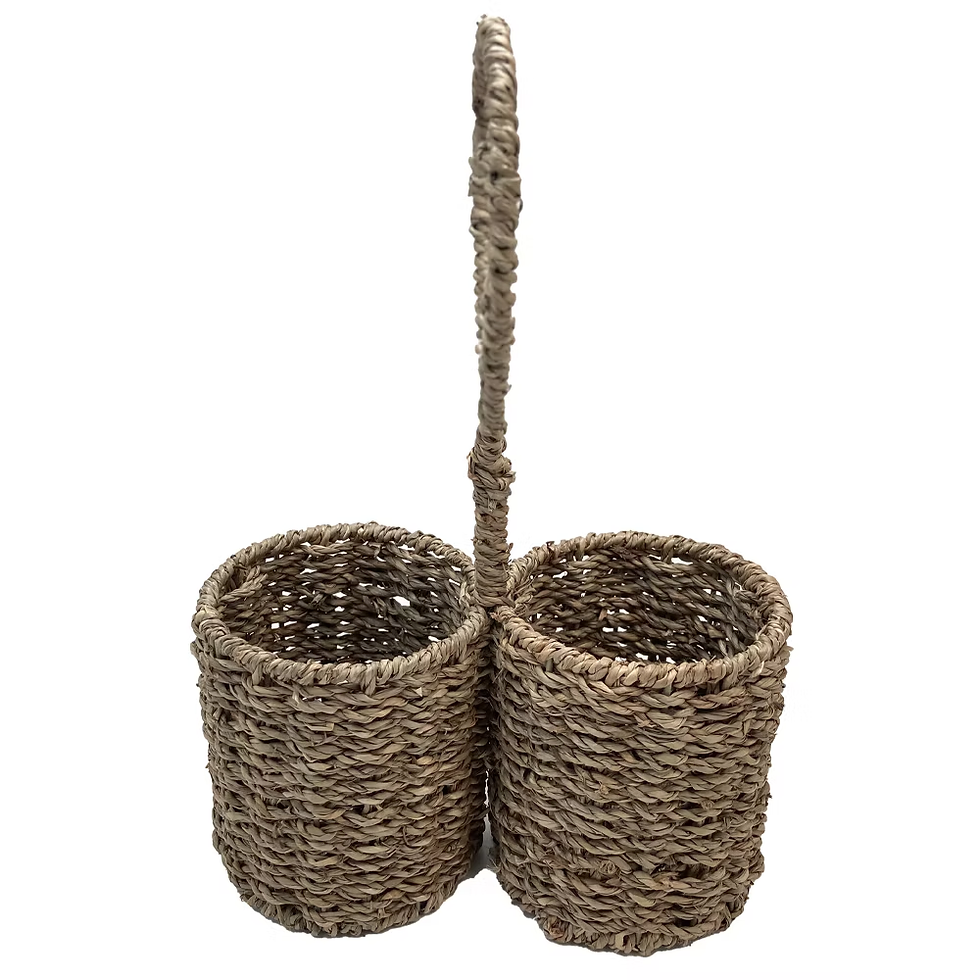
Water Hyacinth 3-Compartment Cutlery Holder with Ring Handle.
Countertops need shape, not just storage
Countertop storage fails when it behaves like backup storage. A kitchen counter is not a stock room. It is a work surface first, and every item left on it has to earn that space visually as well as practically.
That is why bowls and shallow baskets do so much work. They gather loose fruit, wrapped breads, or snack bars, yet they also read as part of the kitchen styling. A deep box looks like overflow. A round bowl looks like placement.
Goldwoven’s kitchen storage page includes fruit bowls, bread baskets, and other woven serving forms designed for pantry, countertop, and dining table use. The deep round seagrass fruit bowl, for example, gives enough depth to contain produce while still keeping the form open and display-friendly.
Round shapes also help with traffic flow. On a crowded island corner, a square basket can feel abrupt because its corners compete with cutting boards, canisters, and appliance edges. A curved basket softens that collision and makes the corner easier to read.
There is a second design reason to use a woven bowl on a counter. Fruit already brings irregular form and color. A textured basket supports that natural look better than a glossy bin does. Apples, citrus, or wrapped baked goods look settled in woven storage because the materials belong to the same visual language: soft, matte, warm, and slightly imperfect.
Still, not every counter calls for a round basket. Near a backsplash, a shallow square organizer can work better, especially for wrapped snacks, coffee pods, or folded dish cloths. The right move depends on whether the basket sits in the center of a surface or along the edge of it.
Best material choices for kitchen use: seagrass, water hyacinth, PP rattan, and natural-look finishes
Material choice should follow the zone. That is the cleanest rule in the whole category. Dry pantry shelves can lean more decorative. Busy breakfast counters need easy maintenance. Areas close to splashes often need a more practical woven surface.
Goldwoven’s kitchen storage page specifically describes a range made from natural seagrass and food-safe PP rattan, while the home storage page adds PP rattan and water hyacinth across a broader storage assortment. The site also notes qualities such as waterproof performance and easy cleaning on selected ranges, which makes the material split quite clear: some constructions lean natural and airy, while others lean more maintenance-friendly.
Seagrass works well when the goal is texture and a natural feel. It suits fruit bowls, bread service, and dry shelf organization. Water hyacinth brings a fuller, softer surface and often reads warmer in open storage. Both make sense when the kitchen line wants visible natural character.
PP rattan or other practical woven constructions make more sense in zones with heavier daily handling. That includes breakfast stations, casual dining service, and family kitchens where wipeability matters more than a purely raw natural finish. The look still reads woven, but the maintenance side is easier.
Goldwoven’s durability blog adds another useful point: weave behavior matters alongside material type. Smooth surfaces reduce snagging and lint build-up, while balanced density and breathable spacing help with long-term performance and freshness. In plain terms, a good kitchen basket is not just made from the right fiber; it is woven in the right way for the intended task.
That is worth remembering because kitchens ask a lot from storage. Heat changes, quick handling, crumbs, dust, and occasional moisture all show up here. A beautiful material that ignores those conditions will not stay beautiful for long.
How to choose a basket assortment for pantry, tea, and countertop programs
A strong kitchen assortment does not need fifty shapes. In fact, that usually weakens the line. A more convincing program often starts with four essentials: one countertop bowl, one bread or serving basket, one divided caddy, and one square or rectangular pantry organizer.
That structure works because each piece solves a different storage behavior. The bowl handles produce and open display. The bread basket supports table use. The caddy handles small grouped items. The square organizer gives pantry shelves a clean front-facing form.
Goldwoven positions itself as a woven household goods supplier with kitchen storage, home storage, customization, and factory network support. On the homepage, the company states that it has operated since 2012 and works with more than 100 specialized factories across China, Vietnam, Indonesia, the Philippines, and Bangladesh, alongside OEM/ODM and scalable production support. For wholesale collections, that matters because a line rarely stops at one basket. It usually expands into coordinated families.
The site’s kitchen storage page also states that custom sizes, shapes, and colors are available for OEM/ODM kitchen storage solutions, and the home storage page repeats support for wholesale and customization across shapes and colors. That opens a practical path for coordinated assortments: same weave language, different silhouettes, one category story.
In real terms, the best assortment is not the one with the most SKUs. It is the one where every size has a reason to exist. A compact caddy should fit tea bags and stirrers. A medium square basket should suit shelf packets or folded linen. A larger bowl should handle produce or bakery display. When those functions overlap too much, the line becomes hard to present.
Packaging logic matters too, even if it is not glamorous. Nested pieces save space. Open bowls photograph easily. Flat-front baskets label well. Divided caddies explain themselves in one image. For catalog planning and showroom use, those details often matter as much as the material.

Square Natural Look Rattan Organizer for Home Shelving.
Styling combinations that make kitchen baskets feel current
A kitchen basket looks best when the materials around it support the same mood. That sounds obvious, yet many layouts miss it by mixing too many finishes at once. The basket itself is usually not the issue. The pairing is.
For warm, quiet kitchens, woven baskets work especially well with clear glass jars, off-white ceramics, oak shelves, linen towels, and brushed metal accents. That combination makes the weave feel intentional. The basket stops looking like a leftover piece and starts acting as part of the room’s material plan.
For darker kitchens, the contrast matters more. A natural woven basket can lighten black counters, dark walnut cabinets, or charcoal backsplash tile. In that setting, one pale basket often does more than three matching accessories because it breaks the visual weight cleanly.
There is also a good reason not to over-style the basket itself. Once a pantry basket gets lined with too many labels, tags, ribbons, or mixed fillers, the result feels overdesigned. A kitchen basket should still look like it belongs in a working room. Clean edges and honest texture do enough.
Tea corners respond well to repetition. Two matching mugs, one woven caddy, one small tray, and one glass jar can carry the whole zone. Fruit corners respond better to contrast. There, a basket with more texture next to smooth produce and a stone counter usually looks stronger than a perfectly matched set.
The same goes for open shelving. If every shelf uses a different basket shape, the arrangement looks busy fast. One square style and one secondary accent shape are often enough. Restraint reads better than variety here.
Common mistakes that make kitchen baskets look messy fast
The most common mistake is picking a basket that is too deep for the task. Tea packets disappear in it. Small snack bars fall sideways. A simple object turns into a blind container. That is not storage; that is delayed clutter.
Another mistake is ignoring the front view. Pantry shelves are seen from the front, not from above. A beautiful basket with an awkward front edge or a sloppy opening will always look less orderly than a simpler shape with a clean top line.
Mixed materials can also create noise. One seagrass basket, one cotton bin, one wire tray, and one plastic crate on the same open shelf make the shelf feel undecided. A tighter material story always looks calmer, even when the contents are ordinary.
Airflow deserves more attention too. Goldwoven’s durability guide points out the value of breathable design and balanced weave density, especially for keeping storage fresher over time. That matters for kitchens because a sealed-looking basket used for produce, bread, or lightly packaged food will never perform as well as a basket with the right level of openness.
The last mistake is forgetting movement. A kitchen basket gets touched. It gets pulled forward, set down, refilled, wiped around, and moved during cleaning. So the rim, handle, and base finish matter more than many catalogs suggest. If those three parts feel right, the basket usually feels right in daily use.
From sample review to inspection notes: what should be checked
Sample review does not need dramatic language. A kitchen basket usually reveals its quality in a few quiet places: the rim, the base, the corner transitions, the handle attachment, and the smell right after unpacking. Those points tell more than a styled photo ever can.
The rim comes first because it frames the whole product. A clean, even top edge makes the basket look deliberate. A rough rim makes even a good weave feel unfinished. On open shelves, that difference shows immediately.
The base matters for another reason. A pantry basket should sit flat. A countertop bowl should not rock. A caddy with a handle should feel stable when lifted with light contents. These are basic things, but they affect whether the product feels calm or awkward in use.
Goldwoven’s inspection standards page says the QC team follows an AQL-based inspection standard and provides standard inspection reports and inspection photos. That is a useful starting point for kitchen storage lines, where consistent shape, weave regularity, cleanliness, and packing condition matter as much as the overall look.
The durability guide adds useful technical direction as well. Smooth strip surfaces, balanced density, and structurally sound framing all influence how the basket handles wear, airflow, and everyday contact. In plain sourcing terms, the weave should support the intended use rather than just look attractive in a catalog shot.
For development work, the most practical path is simple: review the intended scenario, match the shape to that scenario, then confirm finish consistency with an inspection checklist. If more detail is needed, Goldwoven’s inspection standards page and durable bamboo basket guide are the right supporting pages to keep close during sample review.
A calm kitchen usually starts with one good decision
The strongest kitchen basket lines are not built around novelty. They are built around placement. A shelf basket should make packets easier to group. A tea caddy should reduce small-item drift. A countertop bowl should hold daily items without looking like overflow. Once those three jobs are clear, the rest of the category becomes much easier to shape.
Goldwoven’s current range already gives a practical base for that approach, from kitchen storage forms such as bowls, bread baskets, caddies, and display pieces to home storage formats that suit open shelving and pantry organization. The company also presents customization options, inspection information, and a direct contact page for new project discussions.
Three practical next steps make the selection process cleaner:
Match one basket to one task before expanding the assortment.
Choose shape by placement first, then refine material and finish.
Keep at least one pantry piece, one tea piece, and one countertop piece in the same visual family.
For new kitchen storage development, a bamboo basket line works best when it feels useful on day one and still looks right six months later. For the next step, browse the kitchen storage collection, review the inspection standards, or request a quote / get the catalog / ask for customization.
Buyer Checklist
Copy and use this list before locking a kitchen basket style or assortment:
Define the exact scene first: pantry shelf, tea station, countertop, or dining display.
Match the basket shape to that scene instead of choosing by trend alone.
Check whether the contents need airflow, easy wiping, or stronger structure.
Confirm that the front view looks clean on an open shelf.
Review rim finish, base stability, and handle attachment on the sample.
Group one function per basket: tea, bread, snacks, fruit, linen, or packets.
Avoid overly deep baskets for small items.
Use square or rectangular forms for shelf efficiency.
Use bowls or shallow baskets for visible countertop placement.
Keep materials consistent across the range to reduce visual clutter.
Ask for size, shape, and color options only after the use case is fixed.
Request inspection standards or a quality checklist for final review. Goldwoven states that inspection reports and photos are part of its QC process.